Upgrading a Landed Home to Three-Phase Power: What Actually Happens
Solar, an EV, induction cooking, a pool — as home electrical loads climb, more landed homes outgrow single-phase. The real process: who applies to SP Group, what gets replaced, the official connection charges, and how long it takes.
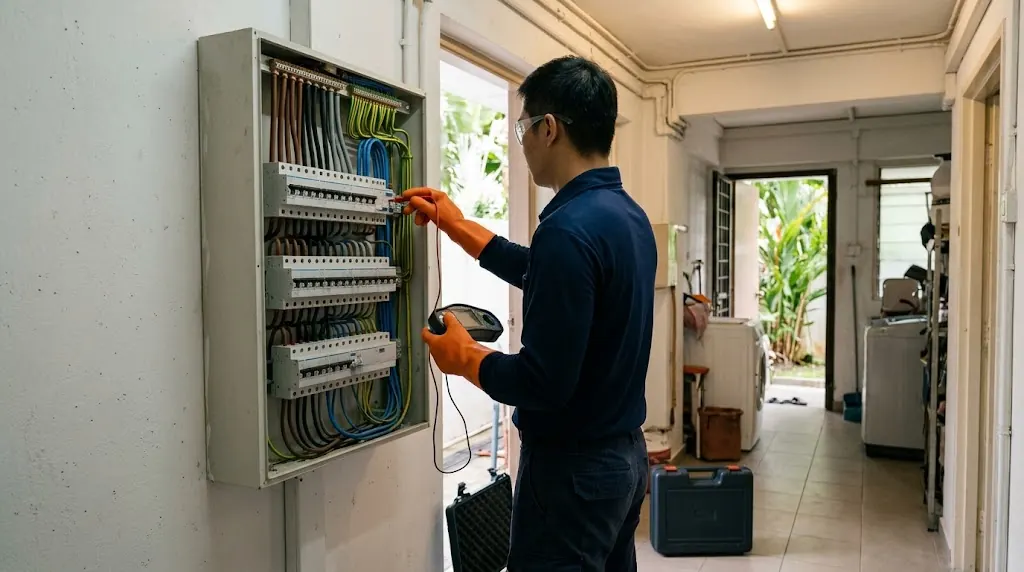 Illustration
On this page (8)
Homes are drawing more power than ever — induction cooking, several aircon zones, instant water heaters, a pool pump, a home lift, rooftop solar and a battery, and increasingly an EV in the porch. Stack enough of it and a normal single-phase supply simply runs out of headroom. The fix is a three-phase upgrade — one of the bigger electrical jobs a home can take on, and one that involves SP Group as well as your electrician.
(In plain terms, "phases" are the separate live lines that feed your home. A normal house runs on one line — "single-phase". A bigger supply runs on three — "three-phase" — so it can carry far more power at once, a bit like a three-lane road versus a single lane.)
Here is what actually happens, who does what, what SP Group officially charges, and how long to budget for — the honest version, not a sales pitch.
First: do you actually need three-phase?
Start here, because the honest answer is often no. Three-phase isn't about any single appliance — it's about your total load, everything that might run at once. A single-phase home supply tops out at about 23 kVA (kVA is simply the size of your supply — how much power the house can pull at any one moment), which is 230 V at 100 A. You reach for three-phase when the combined demand outgrows that.
The usual culprits, stacked together: several aircon zones, induction cooking, instant water heaters, a swimming-pool pump, a home lift, a workshop — a sizeable rooftop solar system with a battery (larger solar uses a three-phase inverter, which spreads the generation evenly across all three lines in a way single-phase can't) — and, yes, a fast 22 kW EV charger. Any one of these alone is usually fine on single-phase; it's the pile-up, now and in the years ahead, that tips a home over.
And household loads only travel one way — up. As homes electrify — induction replacing gas, heat-pump water heaters, solar and batteries, one or two EVs — the sensible time to go three-phase is during a renovation, while the board and walls are already open, rather than scrambling for it later.
One myth worth killing early, though: a normal 7.4 kW EV charger runs perfectly well on the single-phase supply you already have. It's only the fast 22 kW charger that needs three-phase — so if EV charging is your only reason, you may not need an upgrade at all. Check before you spend. Still weighing it up? Our Do you need three-phase power? guide is the decision piece; this one is about how the upgrade actually happens.
Tell us the loads you're planning — aircon, induction, solar and battery, a pool or lift, an EV charger — and we'll tell you honestly whether a three-phase upgrade is genuinely needed, or whether your existing supply already copes. It's a five-minute WhatsApp, not a sales visit.
Ask if I need three-phaseAbout 23 kVA on single-phase
230 V at 100 A — the ceiling for a single-phase home supply. You reach for three-phase when everything that might run at once outgrows that, not because of any one appliance.
What a three-phase upgrade actually changes
A supply upgrade isn't one job — it's a coordinated set, and the split between what SP Group owns and what your side owns matters, because it decides who does what and who pays for what.
- ›The meter compartment — SP requires the meters at your front gate pillar or perimeter wall, in a weatherproof box that can be read without anyone entering your property. A three-phase upgrade commonly means rebuilding this to SP's spec.
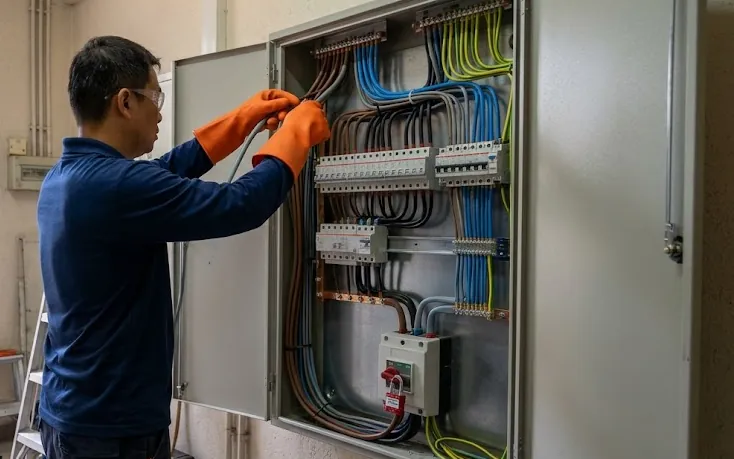
- ›The main switch and distribution board (the "DB" — the grey unit of switches that feeds the house) — replaced with three-phase gear, and the circuits shared out evenly across the three lines so no single line is overloaded. Modern boards are "split-load": the house is divided into a few protected groups, each with its own safety trip, so if one circuit faults, only that group cuts out — not the whole house. Larger homes often add sub-boards for the attic, outdoor and pool circuits.
- ›Earthing — checked and, on older houses, often upgraded. A proper earth is the invisible bit that makes all the other protection actually work.
 Illustration
SP Group's side
- › The incoming service cable to your house
- › The meter (SP owns and maintains it)
- › Digging and reinstating the public road/verge
Your side (via your contractor)
- › The weatherproof meter compartment at the gate
- › The new three-phase main switch and DB (electrical box)
- › Load balanced across the three phases, earthing
- › The UPVC lead-in pipes to the boundary
SP brings power to your gate; your electrical contractor builds everything from the gate inward — and only SP may remove your old single-phase connection once the new supply is live.
The process: your electrician and SP Group, step by step
The single most important thing to know: your electrician applies to SP Group, not you. Any new connection, upgrade or rewiring must be carried out or supervised by an EMA-Licensed Electrical Worker (LEW) — a government-licensed electrician legally allowed to sign off this kind of work; you can verify any LEW's licence on EMA's ELISE portal. The LEW acts as your agent: you sign a letter of consent and hand over a site plan, and they do the rest. So step one is simply engaging the electrician — everything else follows.
- ›Your LEW works out the load, then files the supply application through SP Group's online eBusiness Portal with your letter of consent and site plan.
- ›SP generally replies within about 10 business days with a quotation stating the connection charge (the fixed fee, covered below).
- ›You pay and sign; SP then assigns a project officer and sends an introduction letter. (SP takes card up to S$40,000, or NETS.)
- ›SP gets the permits to dig in public areas from LTA / PUB / NParks — this alone typically takes about three weeks — then lays the incoming cable, roughly another three weeks.
- ›Once the cable reaches your gate and your side is built, the LEW books the turn-on and submits the paperwork that certifies the work is safe and up to code — Form CS/5 and the Certificate of Compliance (COC). You don't touch any of this; the LEW handles it.
- ›SP inspects; on a pass, a Statement of Turn-On is signed on the spot and the supply is switched on. The first inspection is free.
For a standard landed three-phase connection, no separate EMA electrical-installation licence is needed — that only applies to much larger or non-home premises. Your LEW's certificate and SP's inspection are the sign-offs. And you keep your existing utilities account: a single-to-three-phase change stays at low voltage, so there's nothing new to open.
Your electrician applies to SP Group, not you
The LEW acts as your agent. You sign a letter of consent and hand over a site plan; the application, the certification and the turn-on paperwork are all theirs.
What it costs
Two parts make up the bill, and only one has a fixed published price. First, SP Group's standard connection charge — a flat fee for a given supply size that, helpfully, is the same no matter how far your house sits from the mains (SP averages it across landed owners). These are SP's official rates for a standard shared-network underground connection:
- ›Watch the small print: a missed or rebooked turn-on appointment costs S$45 (+GST), and meter testing is S$30 (+GST) per meter — separate from the connection charge.
The work on your side — the new three-phase board, the rebuilt meter compartment, the main switch and any rewiring — is a site-survey question, not a price you can look up. Published guides put a new three-phase board alone at roughly S$900–S$3,500 depending on size and brand, but the total swings on your meter position, cable run and the condition of your existing wiring. That's exactly why any serious quote for this work is itemised — and why a suspiciously round all-in number is a red flag.
| Supply size | SP connection charge (excl. GST) |
|---|---|
| Up to 15 kVA (existing premises) | S$1,600 |
| Up to 15 kVA (new premises) | S$1,900 |
| 16 – 23 kVA | S$2,800 |
| 16 – 45 kVA (typical landed 3-phase) | S$5,300 (S$5,777 incl. GST) |
| 46 – 75 kVA | S$8,800 |
SP Group standard connection charges, shared-network underground connection (w.e.f. 1 Apr 2025) — always confirm the current schedule at application. A typical landed three-phase supply is 3×63 A (about 43 kVA — roughly double a single-phase home's 23 kVA ceiling), which lands in the 16–45 kVA band, so most upgrades sit at the S$5,300 (+GST) rate. Big bungalows with a pool, lift or several EVs go to 3×100 A. Non-standard cases (e.g. a bigger cable to beat voltage drop, or a remote site) are quoted on a user-pays basis.
How long it takes
Budget in months, not weeks. On SP's own figures, the SP side is about six weeks after you pay — roughly three weeks for the dig permits, then about three weeks to lay the cable — and switch-on normally happens within four to six weeks of your premises being ready. Add your contractor's board and meter-compartment work on top, and a realistic end-to-end allowance for a landed three-phase upgrade is around two to three months from the first site visit. If you're doing it as part of a renovation, start it early: the supply application is usually the longest single wait in the whole job.
Upgrade the supply, or rewire while you're in there?
A three-phase upgrade does not automatically mean a full rewire — that's a condition call your electrician makes, not a default. The triggers for rewiring alongside the upgrade are real, though: ageing or brittle cable insulation, wiring in the old pre-2009 colours, circuits that trip often, or points that run warm or discoloured.
On the colours: Singapore changed its wiring colour code on 1 March 2009 (old red/black singles and red/yellow/blue phases became brown/blue and brown/black/grey), with both allowed during a transition to 1 March 2011 — a change made by EMA. Older wiring doesn't have to be ripped out just for that, but a mixed-colour board is a sign the installation predates a lot of modern practice and is worth a proper look.
One more thing older landed houses often show: weak earthing (electricians measure it as "high earth-loop impedance"). In plain terms, the earth path may not clear a fault fast enough for a big new load — so the earthing sometimes has to be upgraded before a heavy three-phase load or an EV charger goes in. It's checked against the SS 638 wiring code, and it's the kind of thing a site visit catches before it becomes a problem.
One common case: charging an EV
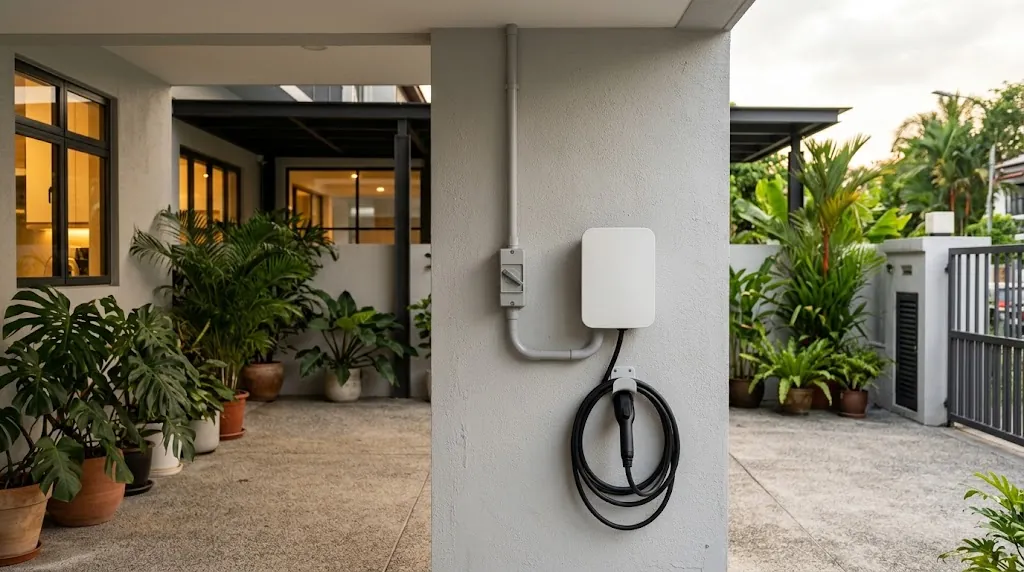
EV charging is one of the most common reasons homeowners look at three-phase, so it's worth a quick note on the charger's own rules (separate from the supply work). The charger circuit itself is wired to SS 638, the national wiring code, and built to Singapore's EV charging standard, SS 722 (elevated from the old TR 25 on 1 April 2026, and mandatory for new chargers from 1 October 2028) — meaning a dedicated circuit, the right safety protection, a properly-rated isolator switch and a type-approved charger, all installed by an LEW. Every charger must also be registered before use on your LTA OneMotoring account.
And to repeat the money-saving point: only the fast 22 kW charger needs three-phase. A 7.4 kW charger runs on the single-phase supply you already have — so confirm which charger you actually want before committing to a supply upgrade for it.
On a 22 kW landed charger we fit three safety parts, each sized to the job: a 32 A four-pole MCB (the breaker that cuts power if the circuit is overloaded), a 40 A four-pole 30 mA Type A RCCB (the life-saving switch that trips in a fraction of a second if electricity leaks to earth — the type that works together with a modern charger's own built-in DC protection; our Type A vs Type B RCD guide explains why most home chargers can use it), and a 32 A four-pole isolator. Because it's a home and not a commercial charging bay, no emergency-stop button is required. If a quote leaves out that leak-protection device, ask why.
A 7.4 kW charger runs on the supply you already have
Only the fast 22 kW charger needs three-phase. If EV charging is your one reason for upgrading, check before you spend — you may not need this at all.
 Illustration
How BSH does it
Three-phase supply, switchboards and heavy-load design aren't a sideline for us — they're core work. For over 30 years, BSH has designed and installed three-phase distribution boards and main switchboards for commercial and industrial buildings across Singapore, as well as for landed homes. So when it's your house, you're getting a contractor whose everyday work is exactly this class of heavy electrical — not a residential-only outfit sizing a three-phase board for the first time.
What that means in practice: we check whether your existing supply and board can take the new load before we quote, we run the SP Group application end to end as your agent, and where the board needs replacing we build it properly — split-load protection, balanced across the phases, tested and certified. Two things we hold ourselves to, worth asking any contractor about: we never tap a heavy new load off the meter compartment or the gate-pillar supply (new loads come off the board, wired to SS 638), and our proposals show you exactly where every part will sit before any work starts. BSH is led by EMA-licensed Grade 8 LEWs (with an independent Electrical Engineer where a larger approved load calls for it), is BCA-registered, and has wired Singapore homes and businesses since 1993.
Not sure what your landed home can take?
WhatsApp us a photo of your main switch or electrical box and tell us the load you're planning — aircon, solar, a pool, an EV charger. Our Grade 8 LEW will tell you whether you need a three-phase upgrade, and if you do, what the SP Group and board work involves.
Send a photo of my boardThinking about a three-phase upgrade?
Tell us your loads and send a photo of your board — our Grade 8 LEW will tell you honestly whether you need it, and handle the SP Group application if you do.
FAQ
When does a landed home actually need three-phase power?
When your total load — everything that might run at once — outgrows a single-phase supply (which tops out at about 23 kVA). It is usually the combination that tips a home over: several aircon zones, induction cooking, instant water heaters, a pool pump, a home lift, a sizeable solar-and-battery system, and EV charging. Any one alone is often fine on single-phase; the pile-up, now and in future, is what calls for three-phase.
Do I need three-phase just to install an EV charger?
Only for a fast 22 kW charger, which pulls power down all three lines at once. The mainstream 7.4 kW home charger runs on a single-phase circuit you very likely already have — so if a charger is your only reason, you may not need a supply upgrade at all.
Does a big solar system need three-phase?
A small rooftop system can run single-phase, but a larger solar array — especially paired with a home battery — typically uses a three-phase inverter that spreads the generation evenly across all three lines, which a single-phase supply cannot do well. If solar, a battery and an EV are all on your list, three-phase is usually the sensible base to build on.
Who applies to SP Group for the upgrade — me or my electrician?
Your Licensed Electrical Worker (LEW) applies, acting as your agent, through SP Group's online eBusiness Portal. You sign a letter of consent and provide a site plan. That is why the first step is always engaging the electrician — the SP application flows from there.
How much does SP Group charge, and how long does it take?
SP's standard connection charge for the 16–45 kVA band — which a typical 3×63 A landed supply falls into — is S$5,300 plus GST (about S$5,777), as a flat fee regardless of distance from the mains, for a standard shared-network connection (rate w.e.f. 1 Apr 2025; confirm the current figure). Budget two to three months end to end: about six weeks for SP's side after payment, plus your contractor's board and meter works.
Does a three-phase upgrade mean I have to rewire the whole house?
Not automatically — it is a condition call your electrician makes. Ageing insulation, pre-2009 colour-code wiring, frequent tripping or warm points are the triggers for rewiring alongside the upgrade. Many upgrades are supply-and-board only, with the existing circuits shared out across the three lines.
Can an HDB flat or condo get three-phase?
Generally no — HDB flats and most condo units are single-phase and cannot individually switch to three-phase (only the occasional high-demand penthouse is considered case by case). Three-phase is essentially a landed-home supply. See our guide on whether you need three-phase power for the full picture.
Still planning? WhatsApp our Grade 8 LEW your floor plan — free itemised estimate.
WhatsApp usKeep reading
Do you need 3-phase power?
The decision guide — when single-phase runs out of headroom.
Power Supply Upgrades
Single-to-three-phase, DB and switchboard upgrades by a Grade 8 LEW.
EV charger installation guide
Sizing, RCD type and LTA registration for a home charger.
Choosing a landed-home contractor
Ten questions to ask, and what the cheapest quote leaves out.
Landed Home Electrical
New wiring, rewires and three-phase upgrades for landed homes.