
SS 722 Explained: What Singapore's New EV Charging Standard Means for You
TR 25 became SS 722 on 1 April 2026. What actually changed, whether it is mandatory yet, and what it means if you are installing a home charger now.
On this page (5)
If you are installing a home EV charger in Singapore, you will keep seeing two labels: TR 25 and SS 722. They are the same family of rules at two stages of life. Here is what changed on 1 April 2026, whether it actually affects your install today, and what to look for.
From TR 25 to SS 722
Singapore's technical rules for EV charging started life as Technical Reference 25 (TR 25), first published in 2010 and updated as the technology matured. On 1 April 2026 it was elevated to a full Singapore Standard, SS 722, by Enterprise Singapore and the Land Transport Authority (LTA).
In plain terms: the same safety framework, now a national Standard, with a wider and more detailed scope. It governs how EV charging systems are designed, installed, maintained and operated.
What actually changed
The headline for homeowners is "not much, for a normal home charger" — but the standard's scope grew to keep up with newer charging technology:
- ›Broader coverage of newer systems — wireless (pad) charging, mobile charging units, and battery charge-and-swap stations.
- ›Updated requirements for DC fast charging, aligned with the latest international (IEC) practice.
- ›New guidance on cybersecurity for charger management systems, and on smart-grid / smart-charging integration.
The day-to-day essentials are unchanged: a dedicated circuit, the correct residual-current protection (RCD), a properly-rated isolator, and a charger that is type-approved for use in Singapore.
Is SS 722 mandatory yet?
Not yet — and this trips a lot of people up. According to LTA and Enterprise Singapore, chargers already type-approved under the older TR 25 do not need to be re-certified, and a transition period of about two and a half years runs before compliance with SS 722 becomes mandatory for new chargers — from 1 October 2028.
So a charger approved under TR 25 is still perfectly legal to install and use. What matters is that the unit is type-approved and the installation is done to the current wiring code (SS 638) by a licensed worker.

What it means if you install a charger now
Three things keep you on the right side of the rules, whichever label your charger carries:
- ›A recognised, LTA type-approved charger (there is an Approval ID on the label).
- ›An installation wired to SS 638 and the EV charging standard, by trained electricians under a Licensed Electrical Worker, who issues the Certificate of Fitness (Form 1).
- ›Registration with LTA on your own OneMotoring account before first use — you register it; we hand you the paperwork.
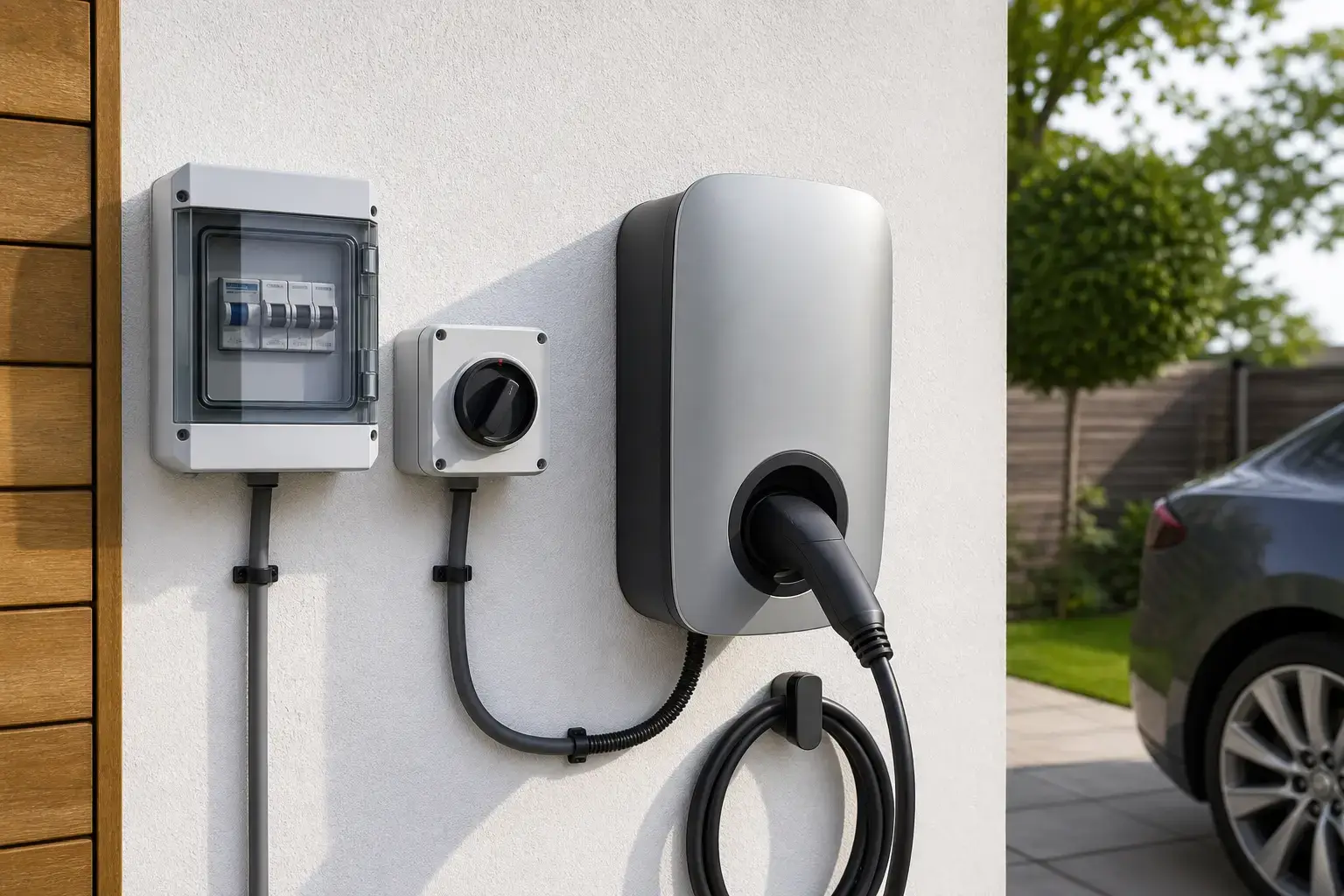
What a compliant home charger install looks like
Behind a tidy charger is a small, well-protected circuit. Tap the parts to see what each does.
Installing a home charger?
We install to SS 638 and the current EV charging standard, issue the Certificate of Fitness, and hand you everything to register with LTA.
FAQ
Is my TR 25 charger still legal?
Yes. Chargers type-approved under TR 25 do not need re-certification, and SS 722 only becomes mandatory for new chargers on 1 October 2028. A type-approved, properly-installed charger is compliant today.
Does SS 722 change the price of my install?
For a normal landed-home AC charger, no — the practical requirements (dedicated circuit, RCD, isolator, type-approved unit) are unchanged. Cost depends on cable run and whether your supply needs an upgrade.
Is SS 722 the same as SS 638?
No. SS 638 is the national wiring code for the electrical installation; SS 722 (formerly TR 25) is the EV-charging-specific standard. Your install follows both.
Do I still need to register the charger with LTA?
Yes — every charger must be registered before use, on your OneMotoring account. We provide the type-approval Approval ID, the Certificate of Fitness and the photos you upload.
Who confirms my install is compliant?
A Licensed Electrical Worker certifies the electrical works (Certificate of Fitness / Form 1), with an Equipment Specialist for the EV-charger registration paperwork.
Still planning? WhatsApp our Grade 8 LEW your floor plan — free itemised estimate.
WhatsApp us